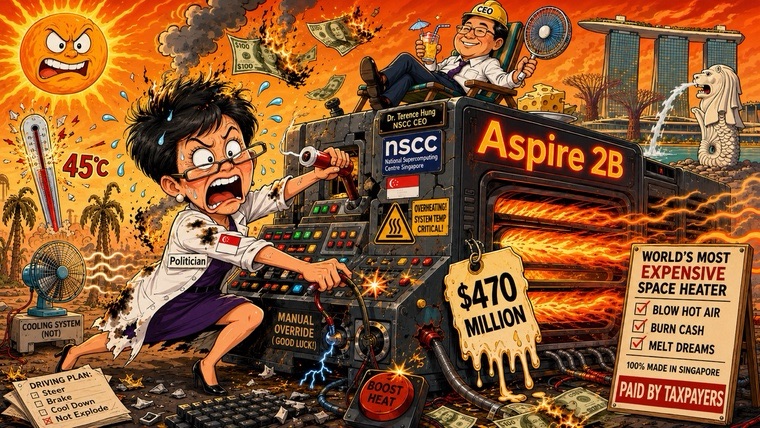
Singapore Built a $470M Supercomputer. Nobody Knows How to Drive It.
How Aspire 2B Became the Most Expensive Space Heater on the Equator


How Aspire 2B Became the Most Expensive Space Heater on the Equator

Three companies worth more than $3 trillion combined want to go public in the next nine months. SpaceX is targeting June 12, 2026. Anthropic filed confidential IPO papers on June 1 for the fall. OpenAI is expected to follow in early 2027. Together, they plan to raise more than $170 billion from public investors. [1][2] For context, every single IPO in the United States last year raised a total of $47 billion. [3] That includes biotech, industrials, and everything else. This is the most important financial story of 2026. Here is what is happening, why it matters, and what to do about it. The Rules Were Changed for This Multiple index providers have adjusted their rules in anticipation of these IPOs. The changes are not coincidental. They are structural. Nasdaq led the way. On March 30, 2026, the Nasdaq approved a new “fast entry” rule for its flagship Nasdaq 100 index, effective May 1. [4] Under the old rules, a newly public company had to trade for three to twelve months before it could join the index. This “seasoning period” was designed to let the market establish a fair price before forcing index funds to buy. Under the new rules, mega-cap IPOs can be added after just 15 trading days. [4][5] The fast entry rule applies only to the largest IPOs — companies that would rank within the top 40 holdings of the Nasdaq 100. At the end of February, that required a market capitalisation of roughly $113 billion. SpaceX, OpenAI, Anthropic, Stripe, and Databricks could all qualify. [4] Nasdaq also restructured its 10% minimum free float requirement. Previously, stocks that did not meet the threshold could be excluded. Under the new rules, low-float stocks are no longer strictly excluded; instead, their weighting in the index is reduced. [4] In practice, this means SpaceX can sell only a small fraction of itself to the public and still enter the index. Companies with free floats up to 33.3% can now be weighted up to three times their prevailing float. [5] The total value of assets tracking the Nasdaq 100 through ETFs alone was $527 billion across 63 funds as of December 2025. [5] The figure is many times larger when institutional mandates and pension funds are included. SpaceX reportedly made fast-track index inclusion a condition for listing on the Nasdaq rather than the New York Stock Exchange. [6] FTSE Russell followed. It shortened its post-IPO seasoning window to just five days and is considering relaxing its already-low 5% minimum float requirement for large IPOs. [4][5] S&P Dow Jones Indices is reportedly weighing whether to halve its 12-month waiting period to six months and abandon its four-quarter profitability requirement. This would be a watershed moment for the S&P 500, which has historically been reluctant to change its inclusion rules. [4][5] CRSP, whose indexes underpin more than $3 trillion in Vanguard fund assets, already allows IPOs after five trading days and is easing its float requirements further. On April 27, it added a float-adjusted market-capitalisation test specifically to accommodate mega-IPOs with limited available shares. [4] The trend is clear and uniform. Every major index provider has moved, or is moving, to accelerate entry for these companies while relaxing the rules that would normally protect index fund investors from low-float volatility. The Problem Here is the chain of events. SpaceX goes public in June, selling a sliver of itself. The typical IPO sells 15 to 25% of the company. SpaceX is reportedly selling far less. [1] Within three weeks, Nasdaq adds it to the Nasdaq 100. Every fund tracking that index must now buy SpaceX stock. Those funds compete with each other to buy from a pool of shares that represents just a fraction of the company. The price spikes not because of any new information about the company’s value, but because the buying is mandatory and the supply is artificially small. This is the Ticketmaster problem applied to the stock market. A concert with 200 seats and 250 buyers is normal. A concert with 10 seats and 10,000 buyers is a feeding frenzy. You are no longer paying for the music. You are paying for access. SpaceX alone expects to raise $75 billion from its offering. OpenAI and Anthropic each plan to raise $60 billion or more. [1][2]The market absorbed $47 billion in total IPOs last year. These three want roughly four times that amount at once. [3] Bloomberg Intelligence analysts have modelled the forced buying wave. If all three companies sell limited shares and get fast-tracked into major indexes, the wave of buying could swallow a majority of all tradeable shares in a short period. [1] The math does not work. Everyone involved knows it. The question is who absorbs the difference. The Insiders’ Exit Strategy There is a lockup period after an IPO. Founders, early employees, and investors who own the vast majority of shares are typically not allowed to sell them for 90 to 180 days. The rule exists to prevent insiders from dumping all their stock on day one. [1] When that lockup expires, the vast majority of SpaceX that was not available starts flowing into the public market. Supply goes from a trickle to a firehose. And the people selling are the insiders who got in at a fraction of the public price. A venture capital firm that invested in SpaceX years ago at a much lower valuation is sitting on enormous returns. They will sell. That is their entire business model. The buyers on the other side are the index funds. Which are your retirement savings. The automatic demand that was built into the stock in week three is now absorbing insider sales at whatever price the market offers. Why the Companies Need This So Badly OpenAI reported $13.1 billion in revenue for 2025 but posted an estimated net loss of $9 billion. [7] Its annual spending is projected to hit $17 billion in 2026, $35 billion in 2027, and $45 billion in 2028. [8] The company does not

We expect lots more AI efficiency news to create new jobs headlines flying in our digital domains and publications.
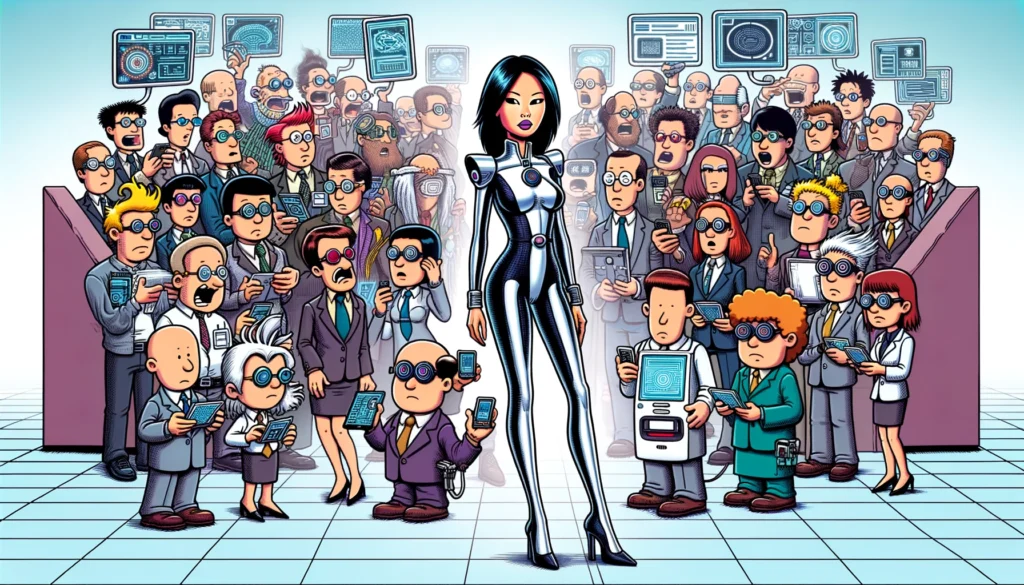
Imagine how our future of works will evolve in this AI dominance world with co-pilot automation that claim to give our quality of life back?

The 8 Show tells the story of 8 individuals who are trapped in a fake scenario in an 8-story building, where they earn money for every minute they’re there.